

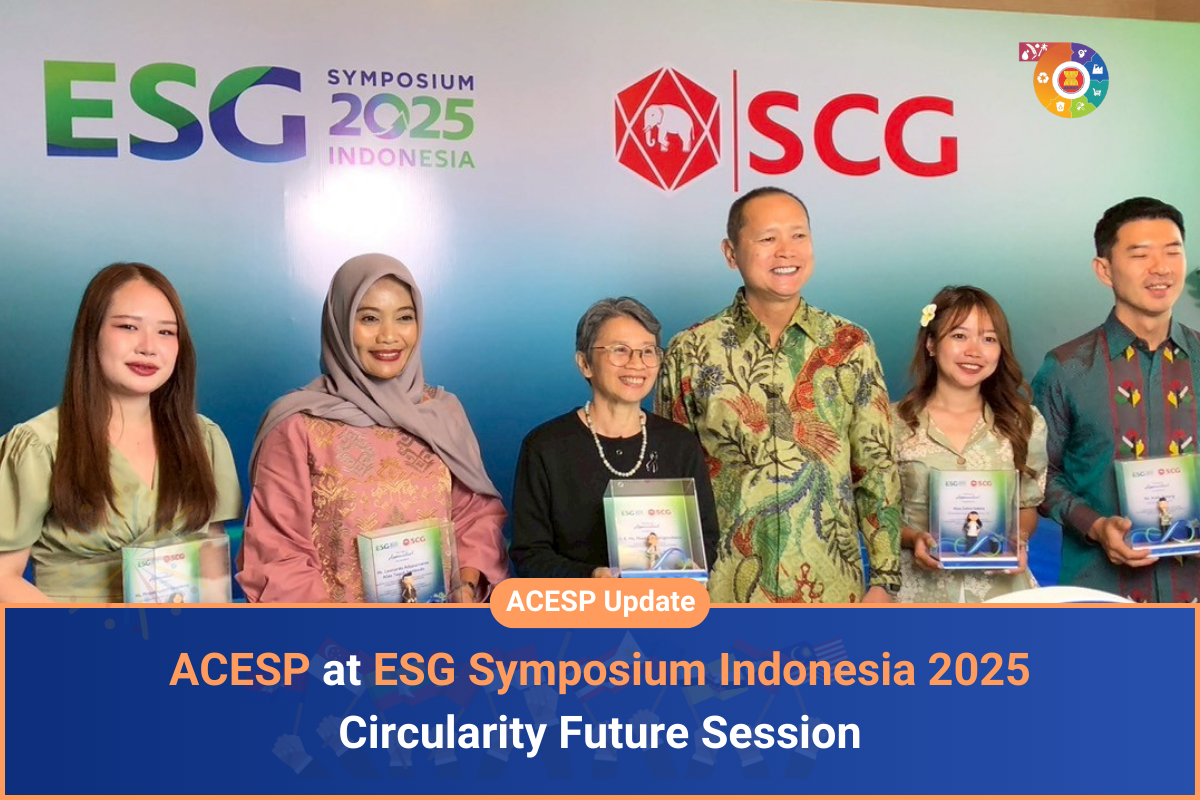
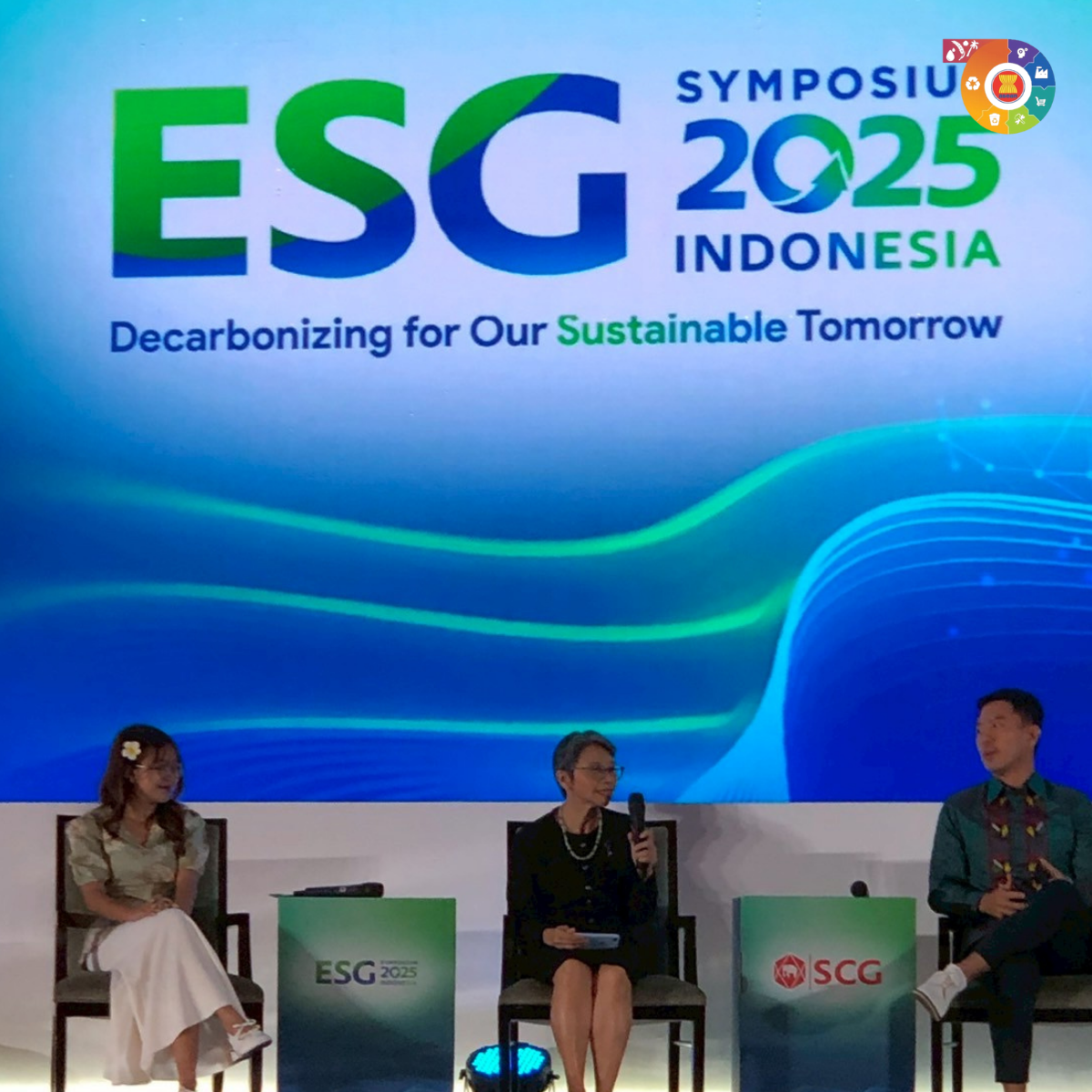
On Tuesday 2 December 2025 at The Ritz-Carlton Jakarta, the ACESP of ACSDSD participated in the Road to ESG Symposium Indonesia 2025, where H.E. Ambassador Phasporn Sangasubana delivered a keynote presentation during the session “Circularity Future – Circular Economy Roadmap.” The session brought together business leaders, government officials, and sustainability innovators to explore how ASEAN can accelerate its transition toward a circular, low-carbon, and inclusive economic future.
🔹 Key Highlights from Ambassador Phasporn’s Presentation
Ambassador Phasporn began by introducing the work of the ASEAN Centre for Sustainable Development Studies and Dialogue (ACSDSD) and its mandate to support research, policy dialogue, and knowledge exchange across ASEAN. She underscored the Centre’s role in advancing the UN SDGs and ASEAN’s complementarities initiative by bridging policy, innovation, and regional collaboration.
🌐 Strengthening Circular Transformation through ACESP
A major focus of the presentation was the development of the ASEAN Circular Economy Stakeholder Platform (ACESP)—a regional facility designed to accelerate sustainable consumption and production. Ambassador Phasporn outlined ACESP’s core functions, including:
- Providing a regional knowledge portal featuring case studies, policy commitments, and good practices
- Fostering alignment across ASCC, AEC, dialogue partners, and the private sector
- Supporting enabling policies, business models, and capacity-building for Member States
- Acting as a convening mechanism through regional dialogues and the annual ASEAN Circular Economy Forum (ACEF)
🌀 The Evolution of ASEAN Circular Economy Forum (ACEF)
Ambassador Phasporn highlighted ACEF’s growth over three pivotal years:
- 2023 – Jakarta: Established the foundation for a carbon-neutral, circular ASEAN
- 2024 – Bangkok: Introduced policy-led circular innovation and entrepreneurship
- 2025 – Kuala Lumpur: Focused on green skills, innovation, and investment—aligned with Malaysia’s ASEAN Chairmanship theme of “Inclusivity and Sustainability”
The progression reflects a shift from high-level vision to concrete, action-oriented strategies.
👥 Why Multistakeholder Collaboration Matters
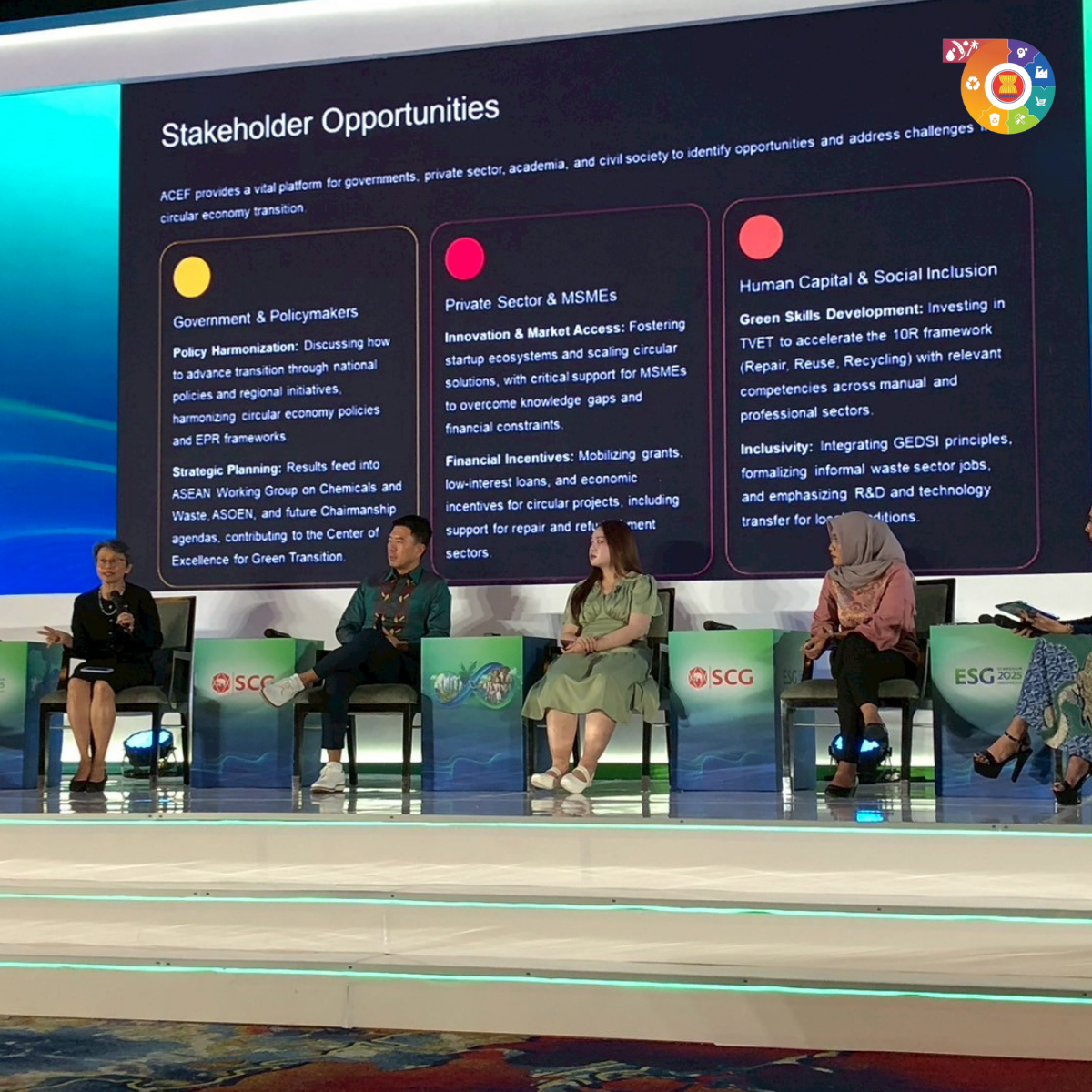
A central theme of the presentation was how circular transformation requires intentional partnerships across government, businesses, academia, MSMEs, and civil society.
Ambassador Phasporn emphasised that through ACESP and ACEF:
- Governments can harmonise policies such as EPR frameworks and ecolabelling standards
- The private sector—especially MSMEs—can access innovation networks, financing pathways, and sectoral support (e.g., electronics repair, reuse markets, waste-to-resource entrepreneurship)
- Human capital development can be strengthened through green skills training, TVET integration, and GEDSI-aligned approaches
- Academia and research institutions can scale circular knowledge, data, and technology transfer
📚 Showcasing ASEAN’s Circular Innovation Landscape
The session also highlighted strong examples of circular economy collaboration and innovation across the region, including:
- The ASEAN Environment Knowledge Hub
- The ASEAN BCG Network led by NSTDA Thailand
- The EU-ABC’s ASEAN Circularity Coalition
- The ASEAN Circular Economy Business Alliance (ACEBA)
- UNESCAP’s ESBN CE Task Force
These networks demonstrate ASEAN’s expanding infrastructure for knowledge exchange, policy innovation, and public-private collaboration. Ambassador Phasporn also showcased pioneering circular business models such as nornnorn’s product-as-a-service mattress system, which integrates recyclability, resource recovery, and life-cycle emissions reduction into a scalable service model.
🤝 The Way Forward — Partnerships as the Engine of Circular Transition
In closing, Ambassador Phasporn highlighted that the future of ASEAN’s circular economy will be shaped by partnership models that:
- Harmonise regional policies
- Mobilise blended finance and de-risk circular investments
- Build shared infrastructure for reuse, recycling, and materials recovery
- Connect businesses, universities, and governments across borders
- Support MSMEs and communities to adopt circular practices at the grassroots level
She emphasised that coordinated, multi-country, multi-sector collaboration is essential for turning circular economy ambition into regional reality.
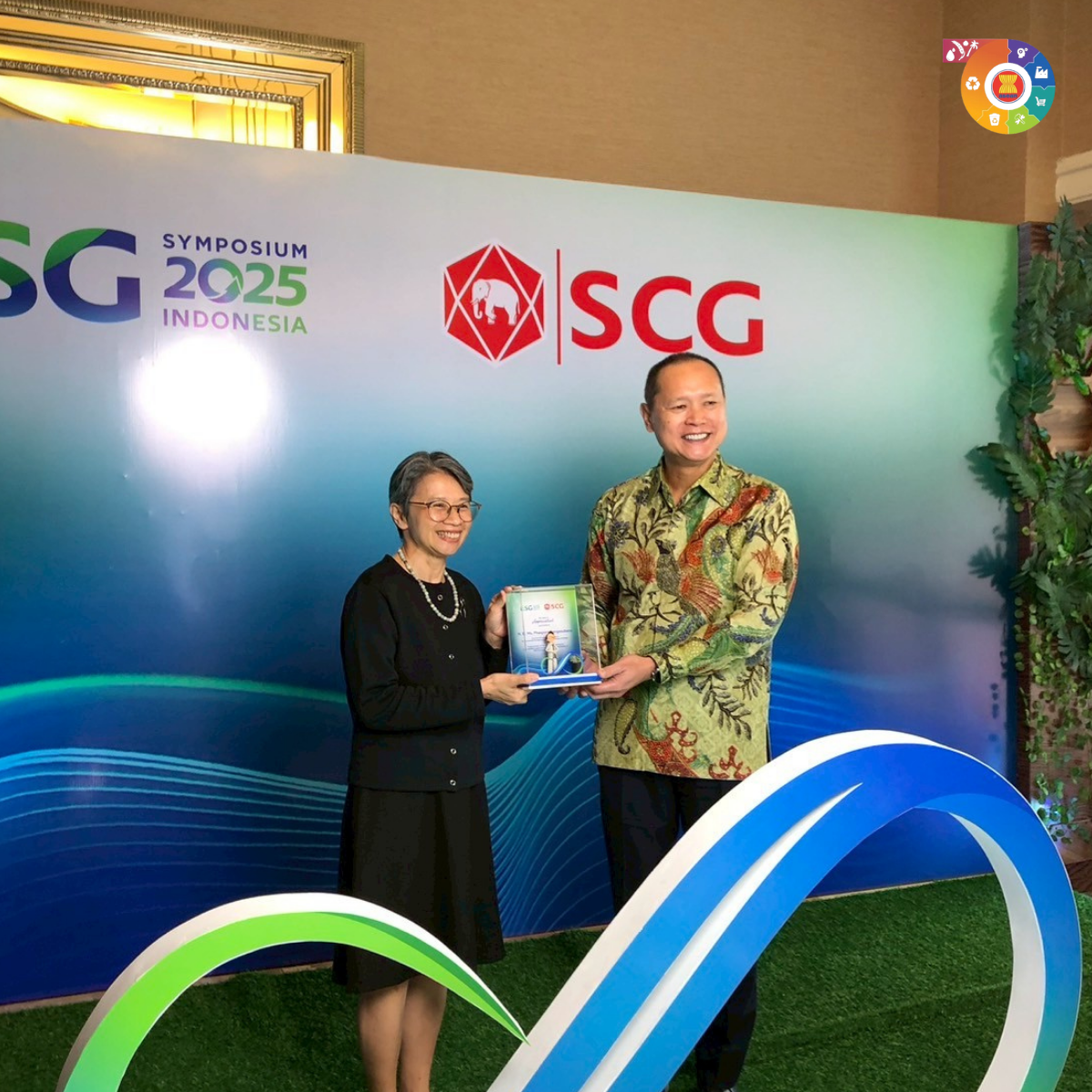
ACSDSD is honoured to contribute to this important dialogue and looks forward to continued collaboration with ASEAN Member States, industry leaders, and regional partners to accelerate a resilient, circular, and inclusive future for Southeast Asia.
About us:
The ASEAN Circular Economy Stakeholder Platform (ACESP) is a regional facility helping ASEAN Member States (AMS) achieve sustainable consumption and production by accelerating the transition towards a circular economy.
Website: ce.acsdsd.org, acsdsd.org
Facebook: ASEAN CE Platform
LinkedIn: ASEAN Circular Economy Stakeholder Platform (ACESP)