

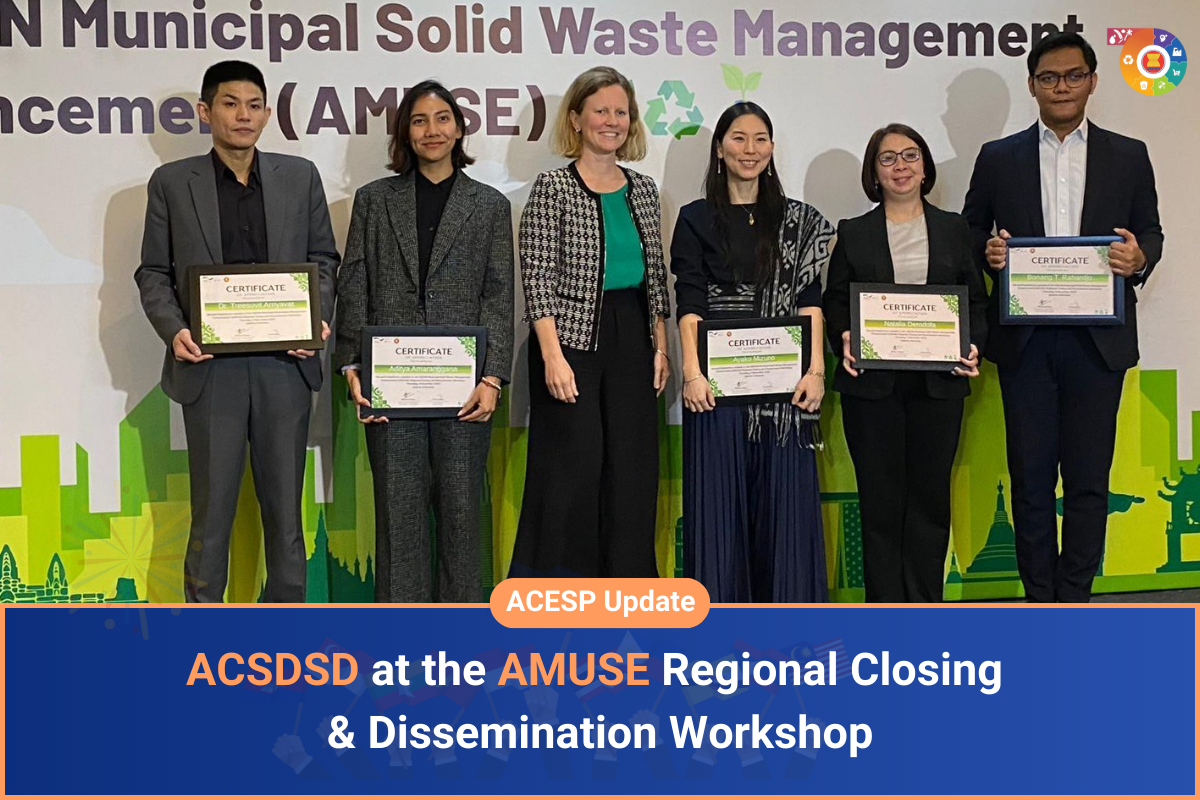
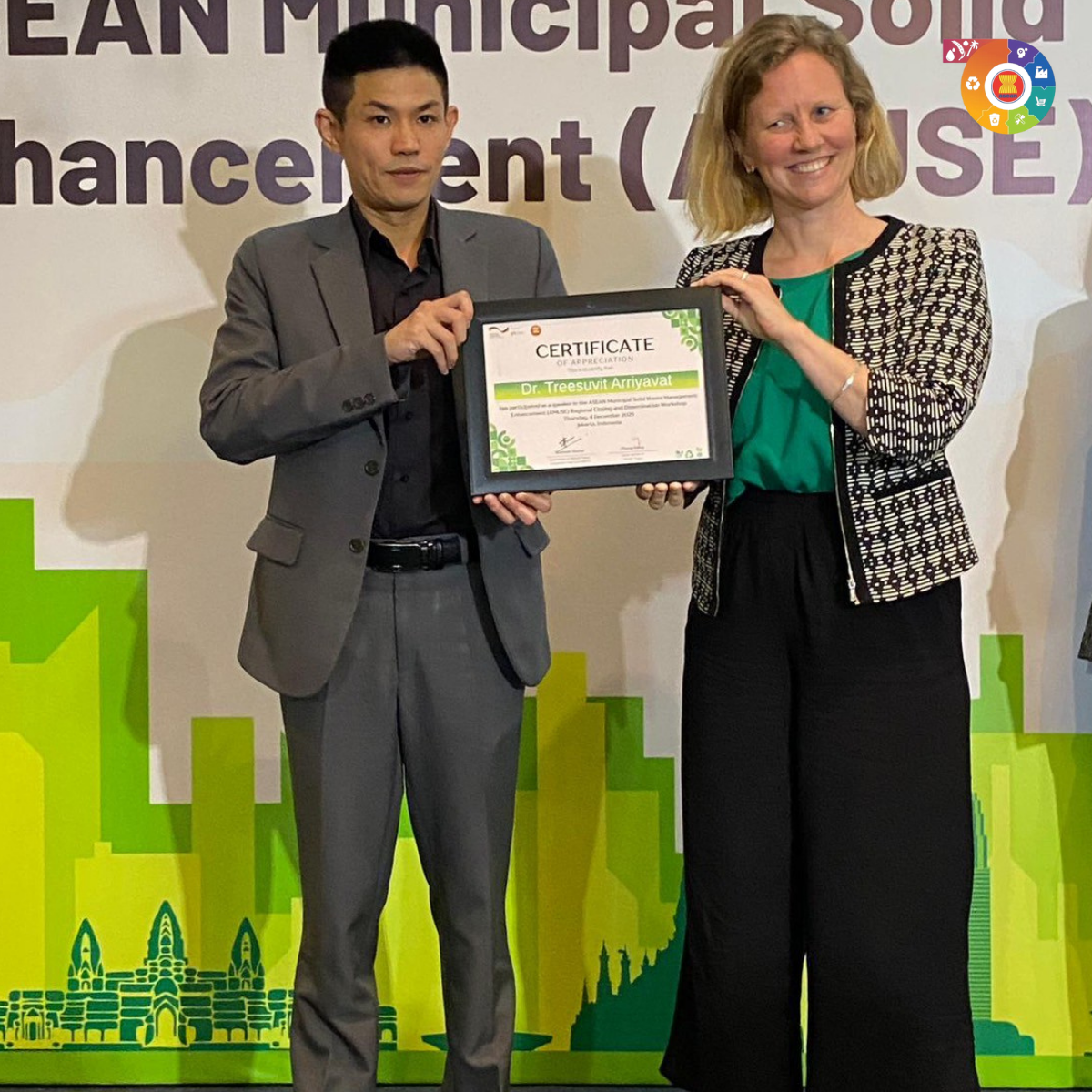
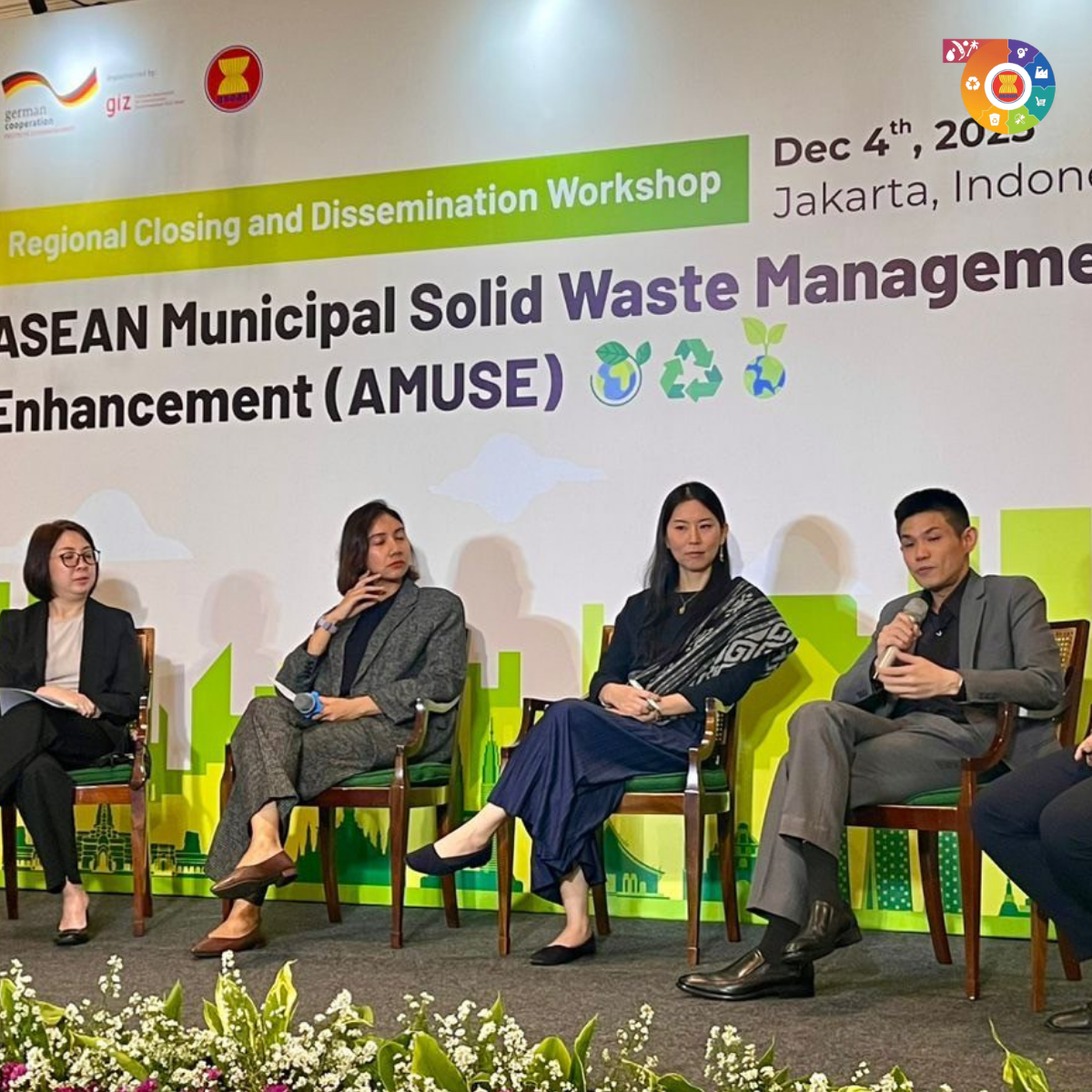
On 4 December 2025 in Jakarta, Indonesia, ACESP of ACSDSD participated in the Regional Closing and Dissemination Workshop, where Dr. Treesuvit Arriyavat joined as a panelist in Plenary Session 3: Regional Cooperation & Knowledge Platform – Achievements and Lessons Learned.
This full-day regional workshop marks the culmination of the three-year AMUSE project, implemented by GIZ and the ASEAN Secretariat with support from the Government of Germany. The initiative has played a vital role in strengthening municipal solid waste management in tourism cities, supporting pilot actions in Cambodia, Lao PDR, Thailand, and Viet Nam, and advancing regional and national cooperation on inclusive and sustainable waste management.
Dr. Treesuvit’s Contribution: Strengthening Knowledge, Cooperation, and Circular Economy Linkages in ASEAN
In Plenary Session 3, Dr. Treesuvit provided insights on how regional knowledge platforms and cooperation mechanisms—such as the ASEAN Circular Economy Stakeholder Platform (ACESP) and the ASEAN Circular Economy Forum (ACEF)—can complement AMUSE’s results and reinforce ASEAN’s long-term sustainability efforts.
Key points shared by Dr. Treesuvit included:
1. The Value of Regional Cooperation in Addressing Cross-Border Waste Challenges
Dr. Treesuvit highlighted how the AMUSE project demonstrates the power of coordinated action across ASEAN Member States. From the Eco-School network to regional waste management frameworks, AMUSE’s work complements broader ASEAN efforts to move towards circular, resource-efficient, and tourism-friendly municipal systems.
He noted that AMUSE’s achievements—especially the cross-sectoral dialogues and inclusive approaches—directly reinforce regional priorities under the ASEAN Environmentally Sustainable Cities (ESC) framework and ASEAN Circular Economy commitments.
2. Launch of the AMUSE Regional Knowledge Platform
As AMUSE officially launched its new regional digital knowledge platform, Dr. Treesuvit emphasised the importance of ensuring long-term continuity of knowledge products and of integrating the platform with existing ASEAN systems such as the ASEAN Environment Knowledge Hub and knowledge partners like ACSDSD.
He stressed that sustainable knowledge management requires:
- Clear governance arrangements for platform maintenance
- Continuous content updates from AMS, development partners, and private sector users
- Alignment with regional circular economy platforms for greater interoperability
- Engagement of academia, local governments, and MSMEs as active knowledge contributors
3. Leveraging ACESP and ACEF for Future Regional Cooperation
Dr. Treesuvit also shared how ACSDSD’s platforms—ACESP and ACEF—can help amplify AMUSE results, particularly through:
- Regional policy dialogue on circular tourism and municipal waste management
- Knowledge codification and scaling of good practices from AMUSE pilot citie
- Cross-sector cooperation involving local governments, the tourism industry, and the waste management sector
- Integration of gender, social inclusion, and informal sector insights—all key features of AMUSE’s approach
He emphasized that these platforms can serve as bridges that connect AMUSE’s outputs to future initiatives, including 3RproMar Phase II and ASEAN’s post-2025 sustainability agenda.
AMUSE’s Impact: A Foundation for Future Circular and Sustainable Tourism
Throughout the workshop, ASEAN Member States and local champions showcased practical solutions from pilot cities such as Siem Reap, Vang Vieng, Nan, Yasothon, and Da Lat. These included initiatives on:
- Strengthening collection, segregation, and recycling systems
- Embedding gender-sensitive and inclusive waste practices
- Engaging communities in sustainable tourism
- Mobilizing public–private partnerships for waste services
The AMUSE knowledge products, pilot city documentation, capacity tools, and gender frameworks were formally shared with AMS and partners—marking a significant milestone for regional collaboration.
Looking Forward: Sustaining the AMUSE Legacy
The workshop concluded with a symbolic handover of the AMUSE Knowledge Platform to the ASEAN Secretariat and the ASEAN Working Group on Environmentally Sustainable Cities (AWGESC), affirming ASEAN’s continued commitment to advancing inclusive, low-carbon, and circular tourism pathways.
Dr. Treesuvit reaffirmed ACSDSD’s readiness to collaborate with ASEC, GIZ, AMS, and development partners—ensuring that AMUSE’s achievements feed into future regional platforms, city-to-city cooperation, and circular economy initiatives across ASEAN.
ACSDSD is honoured to contribute to this important regional effort. We congratulate GIZ, the ASEAN Secretariat, national and municipal partners, and all AMUSE champions for their outstanding work over the past three years.
About us:
The ASEAN Circular Economy Stakeholder Platform (ACESP) is a regional facility helping ASEAN Member States (AMS) achieve sustainable consumption and production by accelerating the transition towards a circular economy.
Website: ce.acsdsd.org, acsdsd.org
Facebook: ASEAN CE Platform
LinkedIn: ASEAN Circular Economy Stakeholder Platform (ACESP)