

Background
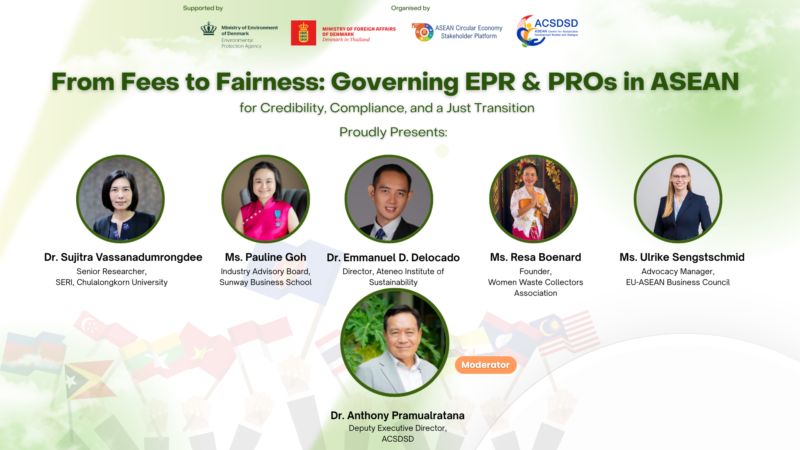
This webinar, “From Fees to Fairness: Governing EPR and PROs in ASEAN for Credibility, Compliance and Just Transition,” offers a critical examination of Extended Producer Responsibility (EPR) and Producer Responsibility Organisations (PROs) in ASEAN. It delves into the multifaceted challenges and opportunities in designing and implementing effective EPR systems, emphasising that success hinges not just on regulation but on fostering trust, fairness, and functional multi-actor governance. Speakers from diverse sectors—academia, industry, civil society, and regional business—share insights on comparative governance models, industry-led PROs, the vital role of the informal waste sector, and the business community’s perspective, culminating in a systems-thinking approach to ensure a truly circular and just transition.
Our speakers’ presentation slides reinforced that EPR in ASEAN is entering a decisive design phase rather than an implementation phase. Many countries are not yet struggling with “how to enforce EPR,” but rather how to architect governance correctly before enforcement begins. Visuals from the slides repeatedly highlighted the risk of replicating governance mistakes seen elsewhere if ASEAN countries rush into operationalisation without first resolving institutional design questions—particularly around PRO governance, data systems, auditing credibility, and integration of existing waste economies.
Topics in the Webinar
The webinar systematically explored the following key areas related to EPR and PROs in ASEAN:
Introduction to EPR as a Multi-Actor Governance System:
- EPR is more than just regulation; it’s a complex system involving regulators, producers, PROs, and local authorities.
- Effectiveness depends on clearly defined roles, robust financing mechanisms, transparency, accountability, and inclusion, particularly of the informal waste sector.
- The importance of addressing governance questions early to prevent entrenched challenges. The presentations from the speakers visually emphasised that EPR does not enter an empty system. It overlays onto long-standing informal and semi-formal recovery networks that already perform much of the recycling function in ASEAN cities. Therefore, poor governance design risks disrupting functioning recovery systems rather than improving them.
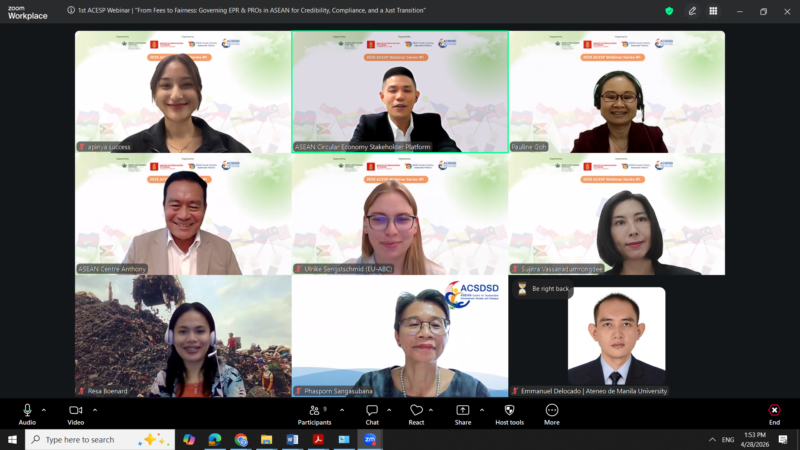
“Its effectiveness also depends on one how roles are defined… how financing mechanisms are designed and governed… how transparency and accountability are ensured and… how inclusion is addressed, especially in contexts where the informal sector plays a critical role.” – H.E. Ambassador Phasporn Sankat Subhan
Comparative Governance Models of EPR in ASEAN (Dr. Sujitra Vassanadumrongdee):
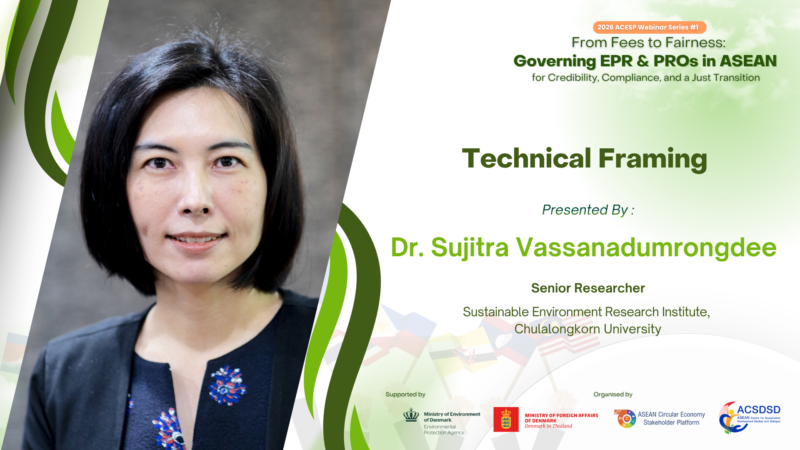
- Current Status:
- Mandatory Schemes: Vietnam (hybrid governmental/PRO model), Philippines (focus on plastic packaging), Singapore (mandatory reporting, deposit refund scheme moving to full EPR).
- Voluntary Schemes/Drafting Laws: Indonesia (revising/drafting), Malaysia (transitioning from voluntary to mandatory), Thailand (drafting act).
- o The diversity of EPR models from Dr. Vassanadumrongdee’s presentation shows that ASEAN is unintentionally running parallel governance experiments. This creates a valuable opportunity for cross-learning before systems become locked in, especially on producer registries, fee calculation methods, and auditing systems.
- Limitations of Voluntary EPR: Limited producer recruitment, narrow scope, lack of strong collaboration, necessitating transition to mandatory schemes.
- Key Needs for Effective Implementation: Clear roles for regulators/PROs, robust data reporting, traceability, transparency, and formal inclusion of the informal waste sector.
- Recommendations: Utilize resources like OECD’s EPR guidelines and the upcoming ASEAN EPR handbook; harmonize producer registries, data collection, and PRO relationships; support eco-design to promote reduction and reuse upstream.
“It’s not just having the law and then finishing—it’s just starting the journey of EPR implementation. We need to work along the stakeholder value chain to transform waste management from an informal to a more formal system – Dr. Sujitra Vassanadumrongdee“
EPR Progress in Malaysia & Designing a Credible Industry-Led PRO (Ms. Pauline Goh):
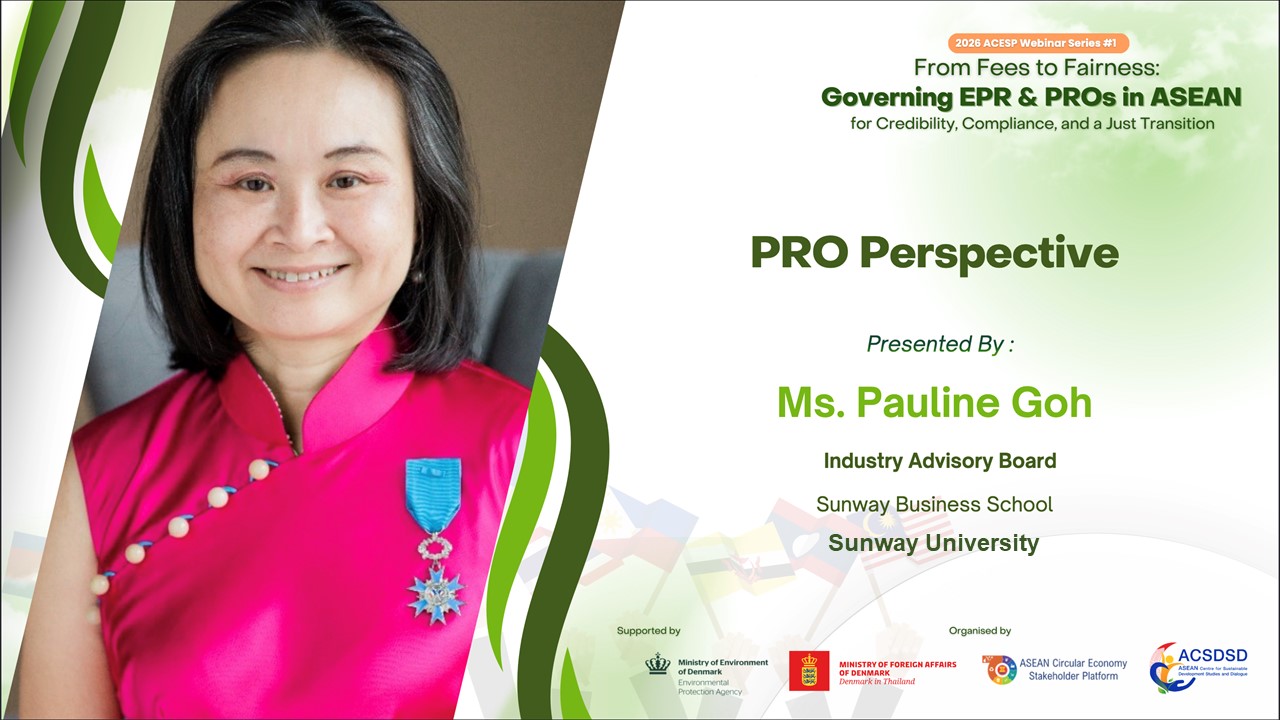
- Malaysia’s Journey:Started with voluntary EPR, MAREA (Malaysian Recycling Alliance) in 2021, now progressing towards mandatory legislation (Circular Economy Act by 2030).
- Planned Implementation Phases: Voluntary EPR (2026-2030) focusing on packaging (plastic, paper, metal, UVC, glass), with defined obliged industries (producers, converters, importers, retailers, e-commerce).
- PRO Models: Flexible approach allowing industry to work through PROs, do self-collection, or a hybrid.
- Recovery Rate Targets: Gradual increase from 40% (packaging) and 20% (glass) in the voluntary phase to higher targets post-2030. Future focus on textile, diapers, rubber.
- Criteria for a Credible Industry-Led PRO: Clear legislation, balanced functions between industry/PRO/government, defined obliged industries, clear recycling targets, standardized reporting/auditing, industry-led fee models, recycled content mandates, eco-design, infrastructure support, and informal sector inclusion.
- Governance Safeguards for PROs: Independent governance structure, separation of roles (government sets rules, PRO executes), mandatory transparency and audited reporting, anti-competitive safeguards (e.g., multiple PROs), and performance-linked fee structures with penalties for non-compliance.
Madam Goh’s presentation emphasised that Malaysia’s model is attempting to avoid a common pitfall: PROs becoming opaque financial intermediaries rather than accountable service organizations. This is why governance safeguards, auditing standards, and anti-competitive provisions were strongly stressed.
“Without legislation, nothing is going to happen. We really need legislation to mandate the obliged industry to do their responsibility and prevent free riders. – Pauline Goh“
Inclusion and Just Transition from Informal Waste Sector Perspective (Ms. Reza Boenard):
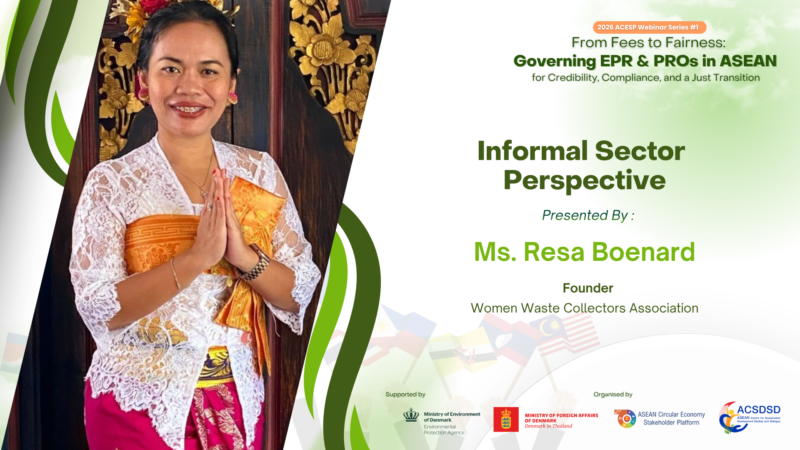
- Waste as Income & Dignity: For informal waste collectors (e.g., in Bantargebang, Indonesia), waste is income and survival; their work provides dignity and contributes significantly to recycling.
- Ground Realities: EPR enters an existing system built by informal workers, but new challenges arise: livelihood uncertainty, reduced access to materials, unpredictable prices, and increased competition.
- Fairness for Informal Workers: Defined as inclusion in the system, recognition of their existing work, and income security. This is about fairness, not charity.
- Call to Action: “Do not replace us, work with us.” Advocates for fair contracts, payment for services, and long-term partnerships, ensuring EPR funds directly benefit collectors, not just big recyclers or startups.
- Principle: Inclusion is not automatic; it must be designed. “If we don’t design for inclusion, we design for exclusion.”
Madam Boenard’s presentation visually reinforced that informal systems in places like Bantargebang are already sophisticated material recovery networks. The risk is that EPR funding may bypass these actors in favour of formal startups or large recyclers unless contracts, payment mechanisms, and recognition are intentionally designed.
“If I don’t collect waste today, my family doesn’t eat tonight. So this is the reality many people live every single day.- Reza Boenard”
Aligning EPR, Eco-Design, and Recycled Content in ASEAN (Ms. Ulrike Sengstschmid):
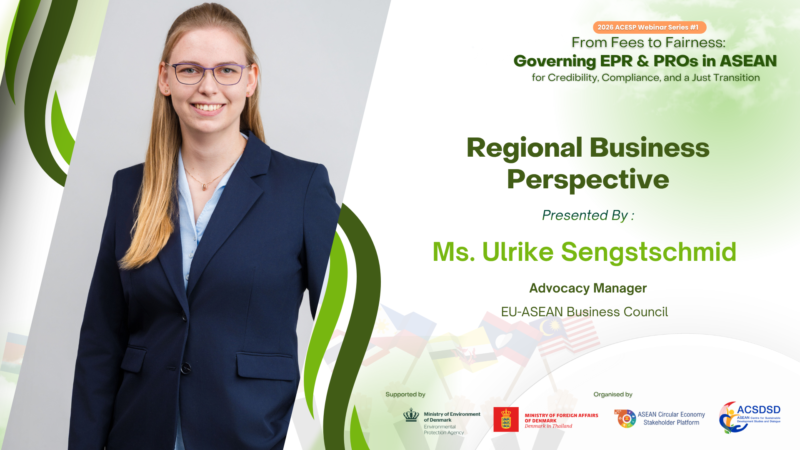
- Green Transition as Economic Opportunity: Circular economy offers investment, job creation, and strengthened competitiveness for ASEAN and businesses.
- Six Key Design Principles for Effective EPR (from EU-ASEAN Business Council): Legislative clarity, industry-led compliance (with government oversight), measurable targets and standards, local adaptation and inclusion, transparent and ring-fenced fee coverage, and upstream incentives (eco-design, recycled content).
- Challenges in ASEAN: Lack of strong, legally binding EPR frameworks, underdeveloped waste management infrastructure, fragmented regional EPR frameworks (hindering compliance for businesses operating across borders), and weak markets for recycled materials (low demand, inconsistent standards).
- Recommendations: Strengthen national EPR policies and infrastructure with significant enforcement; improve regional regulatory alignment on core elements (producer definition, materials covered, fee calculation, eco-design, recycled content standards); build viable markets for recycled materials to complete the circular loop.
Madam Sengstschmid’s slides emphasised a critical gap: weak regional markets for recycled materials undermine EPR effectiveness. Without demand-side policies (recycled content mandates, standards, procurement), EPR risks collecting materials with nowhere economically viable to go.
“For businesses across the region, the green transition is not just an environmental issue, but a significant economic opportunity. Regional regulatory alignment is essential to scaling circular economy practices.- Ulrike Sengstschmid“
Realities of EPR Implementation in the Philippines (Dr. Emmanuel D. Delocado):

- Context: Philippines is a major plastic waste generator (especially sachets) due to the “sachet economy” driven by limited purchasing power and ubiquitous sari-sari stores. Plastic waste is a socio-cultural and economic issue.
- Republic Act 11898 (EPR Act of 2022): Obliges large companies to offset plastic packaging footprint (20% by 2023, 80% by 2028).
- Implementation Hurdles:
- Cultural Context: Dependence on sachets reflects socioeconomic realities; refill stations in malls failed, but partnerships with sari-sari stores worked due to community integration.
- Infrastructure: Plateauing recovery rates due to lack of Materials Recovery Facilities (MRFs) and recycling technologies, especially outside urban centers.
- Auditing/Monitoring: Major challenge for DENR and LGUs to validate recovery and prevent illegal disposal.
- Financial Burden: Smaller businesses (MSMEs) struggle with compliance costs.
- Exclusion of Informal Sector: Junk shops and informal collectors are not yet formally integrated into the EPR framework.
- Systems Approach Needed: Tackle plastic waste from multiple fronts: science/innovation (alternative packaging), economics (tax incentives, subsidies), and behavioral psychology (understanding consumer preferences).
Dr. Delocado’s slides vividly connected plastic waste to the sachet economy and the socio-cultural role of sari-sari stores.This illustrated that EPR cannot be detached from purchasing power, retail structures, and community behavior. Refill models failed in malls but worked with sari-sari stores—showing that behavioral and cultural alignment is as important as policy design. Implementation hurdles around MRF capacity, auditing, LGU capability, and exclusion of junk shops were clearly visualized. The presentation also introduced an important but under-discussed dimension: the role of academia and research in EPR monitoring, data validation, material flow analysis, and policy feedback loops.
“Sustainability… is about balance… if it’s not socially acceptable to people, then it will not work. -Dr. Emmanuel D. Delocado “
Panel Discussion Insights:
- Regional Coherence: Need for ASEAN to learn from each other’s policy instruments beyond EPR, like bans on unnecessary packaging, mandatory recycling content, and pay-as-you-throw schemes. Harmonizing data management and digital registries are crucial to prevent free-riding.
- Governance Safeguards: Emphasized independent PRO governance (independent chair, diverse board), separation of roles, mandatory transparency/audits, anti-competitive measures, and performance-linked fees.
- Empowering Informal Sector: The aspiration for waste collectors to potentially evolve into PROs, highlighting the need for EPR schemes that avoid displacement and ensure direct financial benefit to collectors.
- Deterring Free-Riding: Requires legislative clarity, credible monitoring and reporting systems, consistent enforcement, and active industry involvement in policy design.
- Cultural Context & Behavioral Change: Critical for long-term EPR success; solutions must be grounded in local realities and integrate social and economic aspects, not just environmental ones.
- Strong emphasis on digital registries, traceability systems, and data credibility as the backbone of preventing free-riding and ensuring trust in PRO reporting. This is a foundational issue ASEAN countries must solve early
“This is really about three simple things: Trust, fairness and making the system work in real life.” – Dr Treesuvit Arriyavat
Conclusion
The webinar emphasized that the success of EPR in ASEAN depends on building trust, fairness, and collaboration across the entire system—from regulators and producers to informal waste workers. Governance, not only regulation, will determine whether EPR delivers environmental integrity alongside social justice in the region’s circular economy transition.
ASEAN is at a rare moment where most countries are still designing their EPR systems. This creates a strategic opportunity to get governance right before systems harden, by learning across countries, embedding inclusion early, building credible data systems, and aligning EPR with eco-design and recycled material markets.
Acknowledgment
This Knowledge Brief was prepared by Dr. Treesuvit Arriyavat on behalf of the ASEAN Circular Economy Stakeholder Platform (ACESP) at the ASEAN Centre for Sustainable Development Studies and Dialogue (ACSDSD). The information and contents in this document are the sole responsibility of the authors and do not necessarily reflect the views of ASEAN.
Please click here for the full record: Webinar #1 Record: Governing EPR & PROs in ASEAN for Credibility, Compliance, and Just Transition