

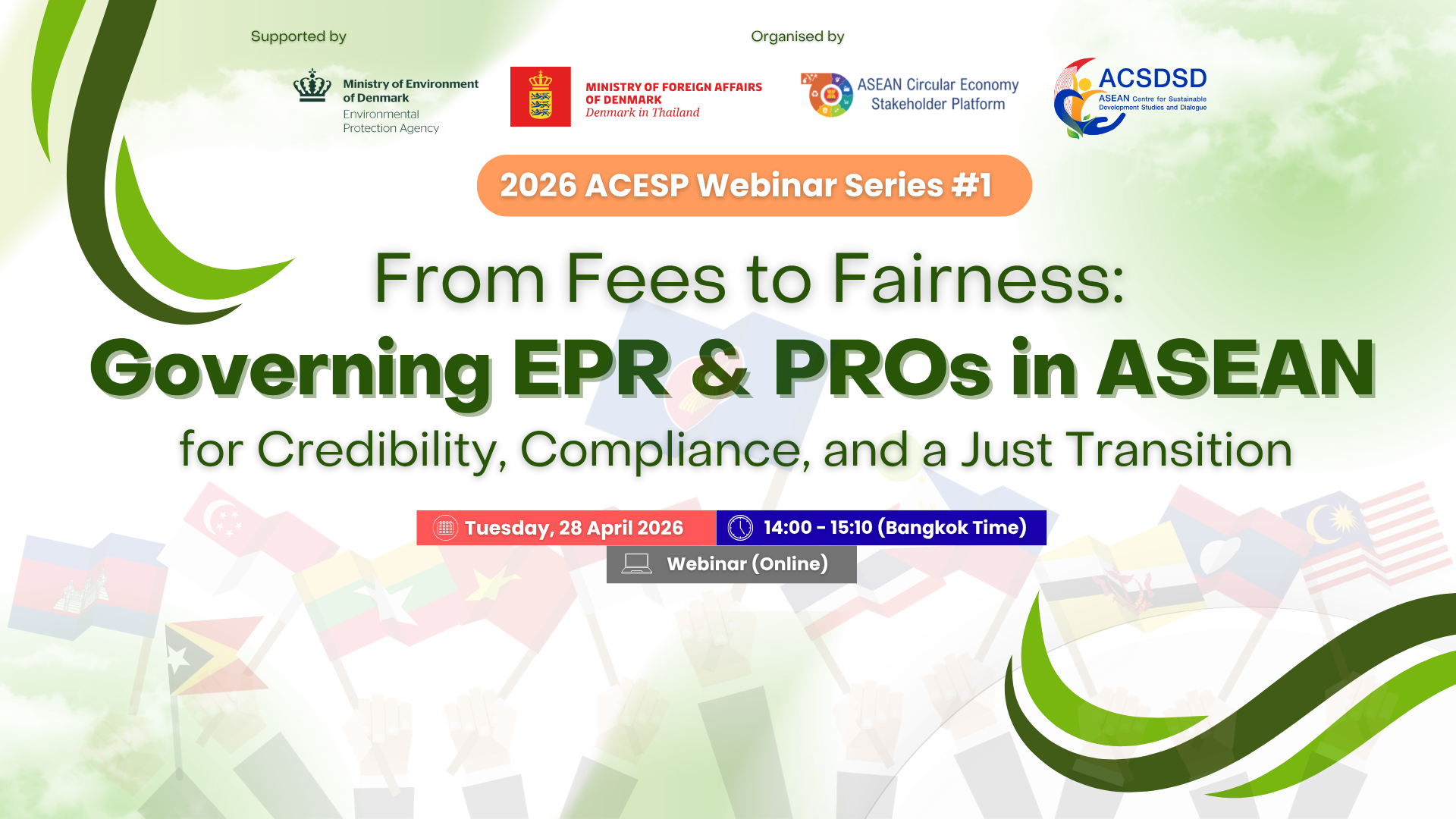
Date and Time:
🗓️Date: Tuesday, 28 April 2026
⏰Time: 14:00 – 15:30 (Bangkok Time)
💻Format: (Online) The link is now available, please click here
Registration:
📌 Secure your spot by registration at: here
Webinar Purpose
This webinar convenes policymakers, Producer Responsibility Organisations (PROs), industry, local governments, recyclers, and informal-sector representatives to examine how governance choices shape the credibility and performance of Extended Producer Responsibility (EPR) systems, with a practical focus on PRO accountability, transparency, enforcement, and inclusion.
The session is designed as an applied policy–practice dialogue. It combines comparative governance framing with operational experiences and stakeholder perspectives to surface reforms that can strengthen EPR implementation outcomes in ASEAN-relevant contexts.
Background and Strategic Focus
Extended Producer Responsibility (EPR) is commonly defined as an approach that shifts significant responsibility for products’ end-of-life management upstream to producers, aiming to support resource recovery and reduce the fiscal and operational burden that would otherwise sit primarily with public authorities.
Evidence across jurisdictions indicates that EPR effectiveness is highly contingent on institutional arrangements, financing design, enforcement capacity, and monitoring quality, with substantial variation in performance linked to differences in regulatory design and implementation conditions.
A recurring implementation lesson is that EPR is not only a “policy on paper” but a multi-actor governance system. Outcomes are shaped by:
- The clarity of stakeholder roles (including municipalities/local authorities),
- The structure of compliance schemes (including collective schemes/PROs),
- The quality of working relationships between producers and local authorities.
Where local authorities are engaged in design and implementation, and where roles and financing are clearly defined, outcomes tend to be more positive. At the same time, industry concerns about cost exposure often influence governance choices.
Within EPR systems, PROs often serve as the operational “engine” that translates legal obligations into collection, recycling, reporting, and financial transfers. However, governance risks and barriers can undermine legitimacy and performance, particularly:
- Transparency gaps,
- Limited trust in reporting systems,
- Misaligned incentives across stakeholders.
In developing countries and mixed-formality contexts, additional challenges include weak enforcement structures and unresolved questions about how to integrate the informal sector without displacing or losing livelihoods. Inclusion, therefore, becomes a practical design issue rather than a purely normative aspiration.
Strategic Focus of the Webinar
- Governance credibility: Who oversees PROs, how conflicts of interest are managed, and what checks exist.
- Accountability and transparency: Fee-setting logic, fund flows, and verifiable reporting.
- Implementation realism: Enforcement capacity, local-government coordination, and workable monitoring systems.
- Inclusiveness and just transition: Practical models for engagement with informal workers and downstream actors.
This session is structured to function as an evidence-informed validation and learning platform. The webinar prioritises implementation issues that repeatedly emerge as decisive for EPR outcomes—especially institutional role clarity, transparency, enforcement, and monitoring.
Key Themes (Webinar Content Pillars)
- Comparative governance models of EPR systems (stakeholder role allocation; central vs decentralized coordination; compliance scheme structures).
- PRO governance and accountability (decision rights, conflict-of-interest safeguards, fee-setting logic, transparency mechanisms, performance verification).
- Enforcement and a level playing field (preventing free-riding; realistic enforcement strategies; consequences for non-compliance).
- Data integrity and monitoring (reporting standards; auditability; information-sharing constraints; digital tools supporting traceability).
- Inclusion and just transition (engagement models with informal collectors; risks of displacement; pathways for fair collaboration and recognition).
Programme
Duration : 75 minutes
| Time | Segment | Speaker(s) | Purpose / Focus |
| Bangkok Times (GMT+7) | Greetings from Dr. Treesuvit Arriyavat (David) | ||
| 14:00–14:05 | Opening remarks | H.E. Ambassador Phasporn Sangasubana
Executive Director, ACSDSD |
|
| 14:06–14:13 | Technical framing presentation | Dr. Sujitra Vassanadumrongdee.
Senior Researcher, Sustainable Environment Research Institute (SERI), Chulalongkorn University, THAILAND |
Comparative governance models; oversight and coordination risks |
| 14:14–14:21 | PRO perspective 1 | Ms. Pauline Goh
Industry Advisory Board, Sunway Business School, Malaysia |
Industry-led PRO governance; financing and transparency |
| 14:22–14:30 | Informal sector perspective | Ms. Resa Boenard
Founder, Women Waste Collectors Association, Indonesia |
Inclusion, recognition, income security |
| 14:31–14:39 | Regional business perspective | Ms. Ulrike Sengstschmid
Advocacy Manager, EU–ASEAN Business Council |
Predictability, coherence, compliance costs |
| 14:39–14:46 | National / Academic Perspective | Dr. Emmanuel D. Delocado
Director, Ateneo Institute of Sustainability |
The Philippines’s EPR Journey, Challenges, and future Research Frontiers |
| 14:47–15:16 | Moderated Panel Discussion Q&A | 25-30 minutes
All presenter joins as panellist |
Moderator
Dr. Anthony Pramualratana Deputy Executive Director, ACSDSD / ACESP |
| 15:17–15:20 | Call for engagement with ACESP | ACESP Communication Team | |
| 15:21–15:25 | Wrap-up/Closing | ACSDSD |
Speakers:
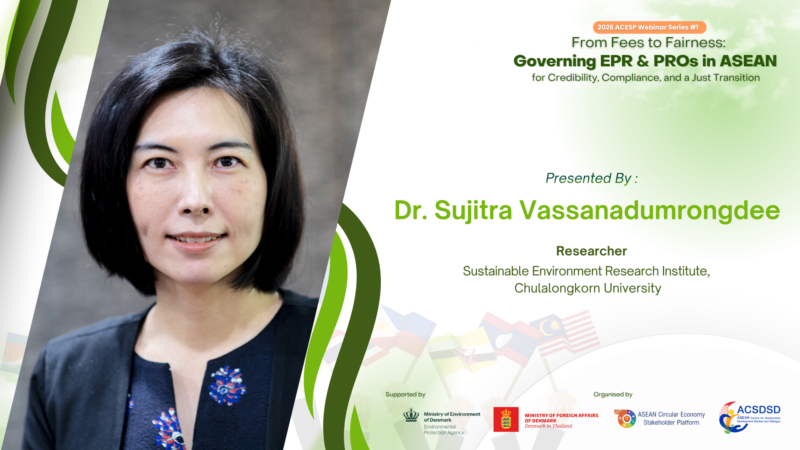
Dr. Sujitra Vassanadumrongdee.
Researcher, Sustainable Environment Research Institute, Chulalongkorn University, THAILAND
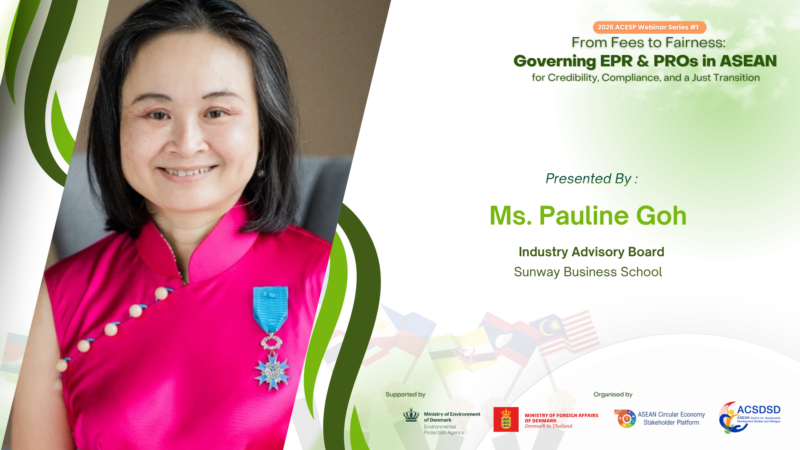
Industry Advisory Board, Sunway Business School
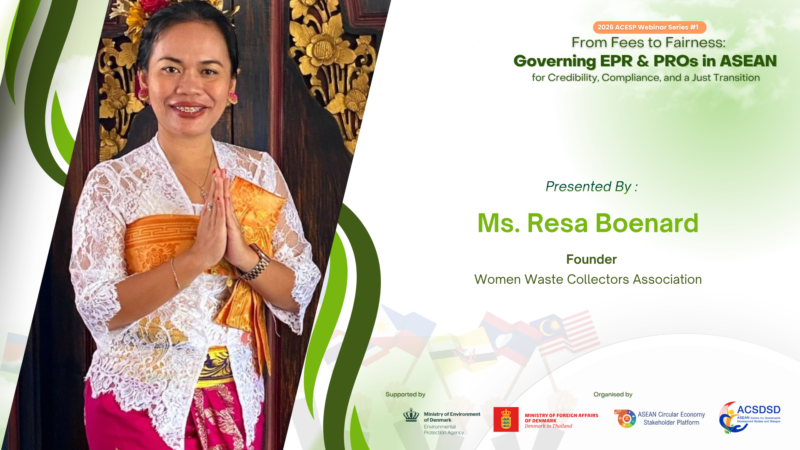
Women Waste Collectors Association, INDONESIA
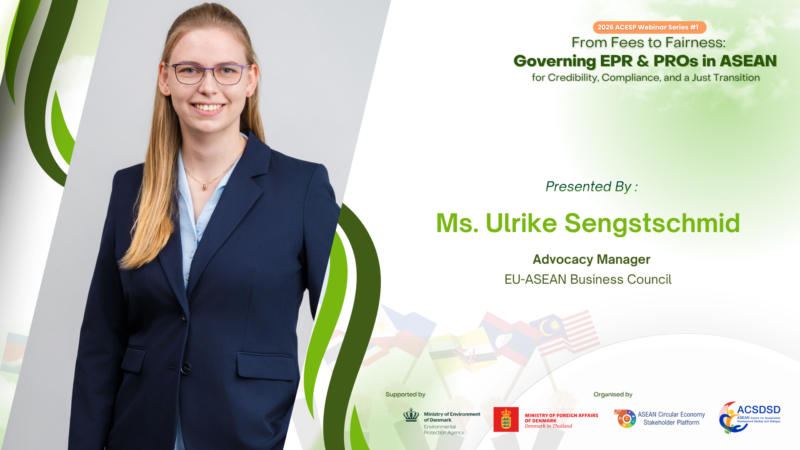
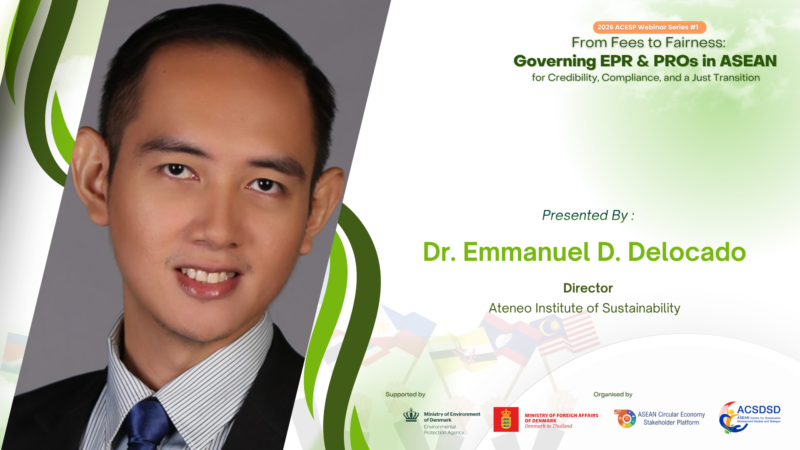
Director, Ateneo Institute of Sustainability
Moderated by:
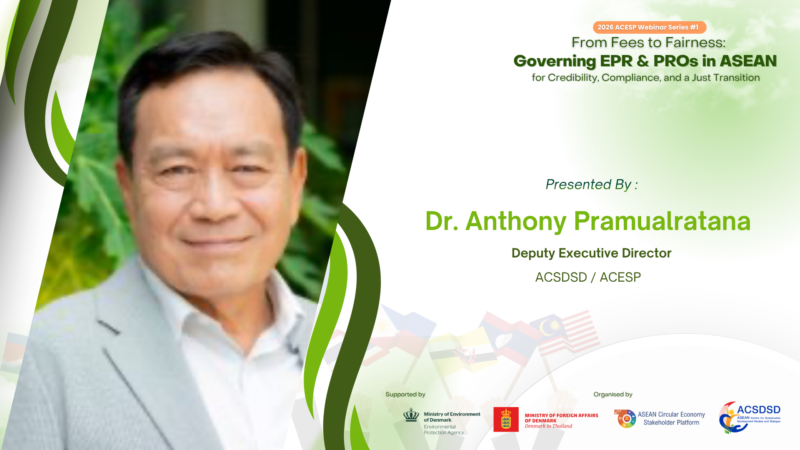
Deputy Executive Director, ACSDSD / ACESP
Master of Ceremony (MC) by:
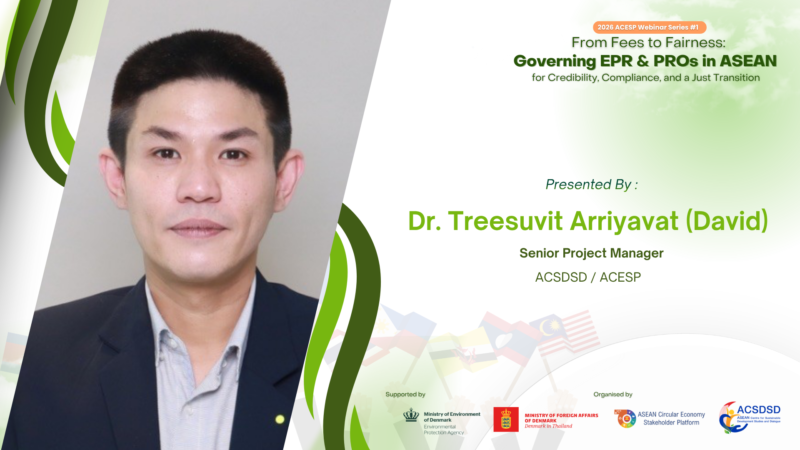
Mr. Treesuvit Arriyavat (David)
Senior Project Manager, ACSDSD / ACESP
Strategic Partnership
The dialogue series is part of the Danish-Thai SSC Project on Circular Economy and Waste Management, Phase 1 (2024-2027) with the support of The Danish Environmental Protection Agency (DEPA) and Royal Danish Embassy, Thailand. (and) Transition to Regional Circular Economy in ASEAN project, implemented by ACSDSD in collaboration with the Stockholm Environment Institute (SEI) and the Global Green Growth Institute (GGGI) under the ASEAN–EU Green Team Europe Initiative, with the support of the Danish Ministry of Foreign Affairs. The project aims to strengthen regional policy alignment, capacity building, and cross-country coordination to advance the circular economy transition in ASEAN.